⚔️ PART I — THE SPECTACLE OF PUNISHMENT
Drawing and quartering a man in the public square while the crowd watches
Quietly reforming his soul on a strict timetable behind closed walls
🔒 The Great Transformation
"At the beginning of the nineteenth century, the great spectacle of physical punishment disappeared; the tortured body was avoided; the theatrical representation of pain was excluded from punishment." The sovereign stopped making a show of destroying the body. Instead, power slipped behind walls and started working on the soul. Less dramatic. Infinitely more effective.

"Humane" reform
18th c. reformers
Public torture
🔒 The Gentle Way in Punishment
"The reform of criminal law must be read as a strategy for the rearrangement of the power to punish... rather than less punishment, more effectively distributed punishment." They didn't abolish torture because they were kind. They abolished it because it was inefficient. The reformers weren't softening power — they were optimizing it.
Punish the body publicly to assert sovereign power
Punish the soul privately through imprisonment
Make punishment invisible — discipline replaces spectacle
Make them punish themselves — the guard tower is empty but they'll never check
🔒 Four Ages of Punishment
"He who is subjected to a field of visibility, and who knows it, assumes responsibility for the constraints of power... he becomes the principle of his own subjection." From Damiens torn apart by horses in 1757 to you checking your screen time app. The technology of power doesn't get cruder — it gets quieter.
🏋️ PART II — DOCILE BODIES
Sovereign Power:
I will destroy your body in the public square to demonstrate my authority
Disciplinary Power:
I will train your body with timetables and drills until you can't even imagine disobedience
🔒 Two Regimes of Power
"Discipline 'makes' individuals; it is the specific technique of a power that regards individuals both as objects and as instruments of its exercise." Sovereign power subtracts — it takes your life, your freedom, your blood. Disciplinary power produces — it makes soldiers, students, workers. The first one looks stronger. The second one won.
Punishing the body
Training the soul through calculated manipulation of the body
🔒 The Soul Is the Prison of the Body
"The soul is the effect and instrument of a political anatomy; the soul is the prison of the body." Foucault inverts Plato completely. The body isn't the soul's cage — the soul is a construct that power uses to control the body. Every time someone appeals to your "character," your "conscience," your "inner self" — that's the mechanism at work.
Learn to sit still and raise my hand at age 5
Learn to follow schedules, meet deadlines, obey the bell
Learn to self-monitor productivity with apps and KPIs
Call it "self-discipline" and "personal growth"
🔒 The Art of Distributions
"A body is docile that may be subjected, used, transformed and improved." You weren't born organized. You were trained — partitioned into spaces, allocated into time slots, ranked against peers. And the final stage is when you do it to yourself voluntarily and call it ambition.

I receive: Your absolute obedience, timetabled existence, and docile body
You receive: The feeling that you chose this freely
DISCIPLINARY SOCIETY'S OFFER
🔒 The Calculated Economy of Power
"Discipline increases the forces of the body (in economic terms of utility) and diminishes these same forces (in political terms of obedience)." The genius of discipline is the exchange: it makes you more productive AND more obedient simultaneously. You think you're winning. That's how they know it's working.
👁️ PART III — THE PANOPTICON

I behave because it's the right thing to do
You behave because the panopticon is inside you now
🔒 The Internalized Gaze
"He who is subjected to a field of visibility, and who knows it, assumes responsibility for the constraints of power; he makes them play spontaneously upon himself; he inscribes in himself the power relation." You don't need a guard tower when the prisoner builds one inside his own skull. That's the whole point.

One does not simply
Escape the panopticon — you carry it with you
🔒 There Is No Outside
"The Panopticon is a marvellous machine which, whatever use one may wish to put it to, produces homogeneous effects of power." You can leave the building. You can't leave the structure. The panopticon isn't a prison — it's a principle. And it followed you home.
Design a circular prison where one guard can see every cell
Make it so prisoners never know if they're being watched
They internalize the surveillance and guard themselves
They internalize the surveillance and guard themselves
🔒 Bentham's Design, Foucault's Diagnosis
"Hence the major effect of the Panopticon: to induce in the inmate a state of conscious and permanent visibility that assures the automatic functioning of power." Bentham designed it as a building. Foucault realized it was a diagram for all of modernity. The guard can leave the tower. The prisoners never find out.

Foucault
Literally any institution
Is this a prison?
🔒 The Carceral Archipelago
"Is it surprising that prisons resemble factories, schools, barracks, hospitals, which all resemble prisons?" The prison didn't fail because it produces delinquents. It succeeded — because every other institution runs on the same logic. Schools grade you, hospitals classify you, factories time you. You just don't see the bars.

Schools
Prisons
Same timetables, ranks, surveillance, and normalization
🔒 The Institutional Isomorphism
"The judges of normality are present everywhere. We are in the society of the teacher-judge, the doctor-judge, the educator-judge, the social worker-judge." Add hospitals, barracks, factories. They all partition space, control time, rank individuals, and enforce norms. The architecture of discipline is copy-paste across every institution you've ever been inside.

Smart home cameras, location tracking, social media monitoring, credit scores
This is fine
🔒 The Panopticon, 2026 Edition
"Our society is not one of spectacle, but of surveillance." Bentham could only dream of what we built voluntarily. We carry the panopticon in our pockets, mount it on our doorbells, and track each other's locations "for safety." Foucault didn't warn us about a dystopia — he described the one we'd build ourselves and call progress.
📋 PART IV — EXAMINATION & NORMALIZATION
I'm a unique individual with—
You're a case file, a GPA, a credit score, and a diagnosis
🔒 The Examination
"The examination combines the techniques of an observing hierarchy and those of a normalizing judgement. It is a normalizing gaze, a surveillance that makes it possible to qualify, to classify, and to punish." The exam doesn't measure you. It produces you — as a case, a record, a data point. Your "individuality" is a file in someone's system.
You're being ranked, measured, and compared to everyone else
At least I'm "normal"
"Normal" is the standard they created to control you
🔒 The Normalizing Judgment
"The power of normalization imposes homogeneity; but it individualizes by making it possible to measure gaps, to determine levels, to fix specialities, and to render the differences useful." Being "normal" isn't natural — it's a disciplinary achievement. The bell curve isn't a discovery. It's a technology of power.
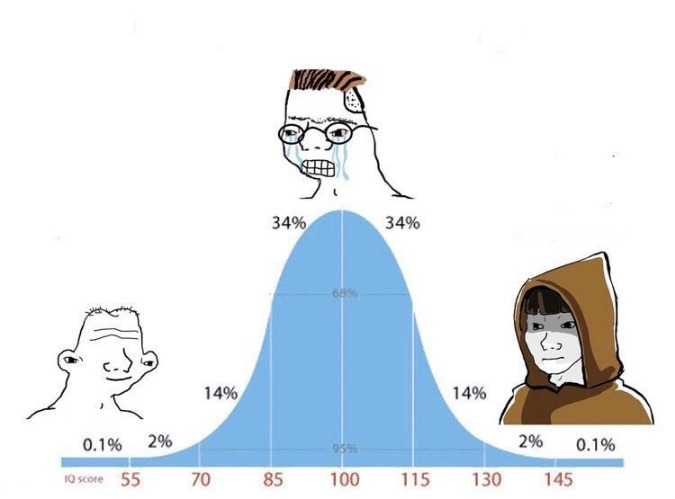
"Deviant"
"Normal" — congratulations, you've been successfully disciplined
"Deviant"
🔒 The Norm as Instrument
"In a sense, the power of normalization imposes homogeneity; but it individualizes by making it possible to measure gaps." The bell curve doesn't describe nature — it prescribes behavior. Stand in the middle and you're "well-adjusted." Drift to either end and you're a case for intervention. The curve is the judge.

KNOWLEDGE IS NEUTRAL AND OBJECTIVE!!
Every "science" of the individual was born in the prison, the asylum, or the clinic
🔒 Power/Knowledge
"There is no power relation without the correlative constitution of a field of knowledge, nor any knowledge that does not presuppose and constitute at the same time power relations." Psychology, criminology, psychiatry — none of them emerged from pure curiosity. They were born from the need to classify, rank, and manage populations. Knowledge isn't power's opposite. It's power's instrument.
🏗️ PART V — THE BIRTH OF THE PRISON

Can't fail at reducing crime
If the prison was never designed to reduce crime in the first place
🔒 The "Failure" of the Prison
"The prison, apparently 'failing,' does not miss its target; on the contrary, it reaches it, insofar as it gives rise to one particular form of illegality in the midst of others." Prisons produce delinquents. That's not a bug — it's the feature. A managed class of criminals is more useful to power than the elimination of crime. The system works exactly as designed.

We'll replace torture with prisons to rehabilitate criminals
And they'll actually reduce crime, right?
...right?
🔒 Two Centuries of "Reform"
"For a century and a half the prison had always been offered as its own remedy... the reactivation of the penitentiary techniques as the only means of overcoming their perpetual failure." Every generation rediscovers that prisons don't work and proposes... more prisons, better prisons, reformed prisons. The prescription for the disease is always more of the disease. Foucault saw the loop.

I bet he's thinking about other women
If the school, the factory, and the barracks all use the same techniques as the prison, then we've all been inmates our entire lives and "freedom" is just a less visible cell
🔒 The Carceral Continuum
"The carceral texture of society assures both the real capture of the body and its perpetual observation." There is no bright line between prison and society. The school feeds into the barracks feeds into the factory feeds into the prison feeds back into the school. It's not a system with prisons in it — it's a prison system that occasionally lets you go outside.

The soul is the prison of the body — change my mind
🔒 The Inversion of Plato
"It would be wrong to say that the soul is an illusion, or an ideological effect. On the contrary, it exists, it has a reality, it is produced permanently around, on, within the body." Plato said the body traps the soul. Foucault says the soul — conscience, identity, the "self" — is the real prison. It was manufactured by power and installed in you to make the body governable. The twist that makes all of Western philosophy uncomfortable.
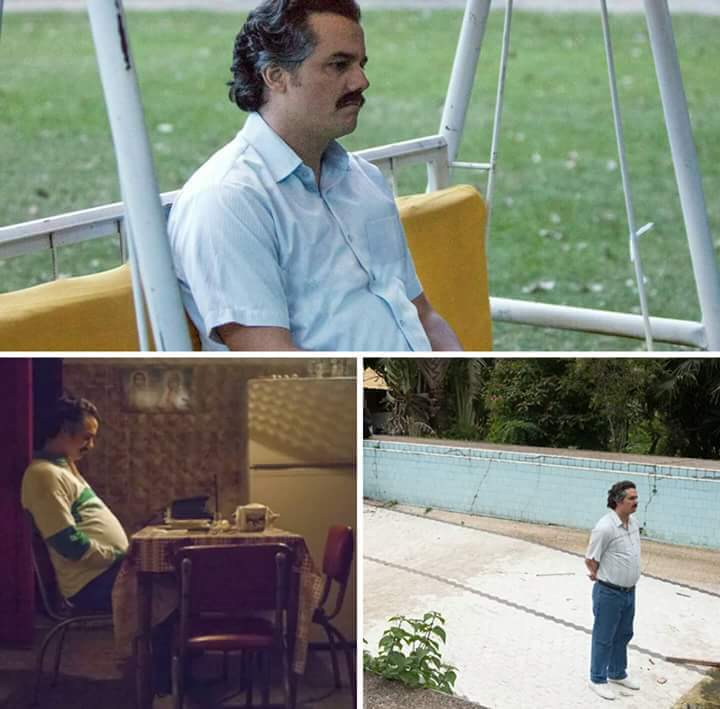
After reading Discipline & Punish and realizing
You've been in the panopticon your whole life
🔒 The Foucault Effect
"We are neither combatants on the stage of representations, nor subjects of the law; we are those who are disciplined." Every reader of this book goes through it: the slow realization that the timetable you follow, the norms you obey, the identity you "chose" — all of it was produced by the same machinery. Pablo sitting alone in his empty mansion has never been more relatable.

"I'm a free individual making my own choices"
i'M a FrEe iNdIvIdUaL mAkInG mY oWn ChOiCeS
🔒 The Illusion of Autonomy
"The individual is no doubt the fictitious atom of an 'ideological' representation of society; but he is also a reality fabricated by this specific technology of power that I have called 'discipline.'" You didn't choose your schedule, your aspirations, your definition of success, or even your idea of "freedom." Discipline chose them for you, then convinced you it was your idea. SpongeBob gets it.

Waiting for prison reform to actually work
Since 1820
🔒 The Perpetual Reform
"The prison has always formed part of an active field in which projects, improvements, experiments, theoretical statements, personal evidence and investigations have proliferated." Two centuries of commissions, reports, reforms, pilot programs — and recidivism rates are exactly where they were. Foucault's point isn't that we should try harder. It's that the failure is structural. The skeleton will keep waiting.